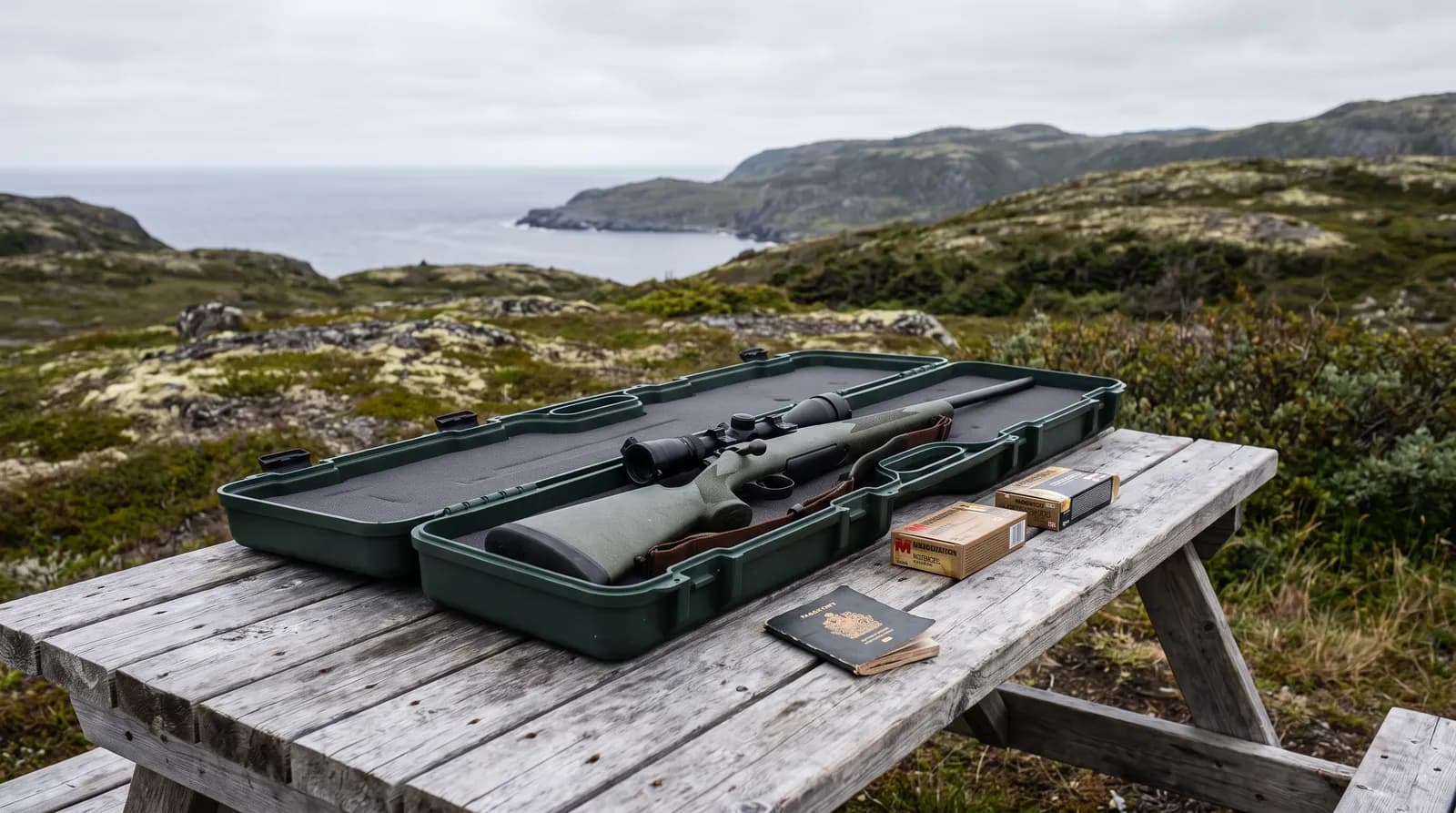
This is a plain-language summary of official rules, not legal advice. Firearm rules in Canada have changed several times in recent years. Check the current Royal Canadian Mounted Police (RCMP) Canadian Firearms Program and Canada Border Services Agency (CBSA) guidance before you travel, and call the Canadian Firearms Program at 1-800-731-4000 if you're unsure about a specific firearm.
Provincial rules for big game
The 2026-27 Newfoundland and Labrador regulation summary says it is unlawful to hunt big game (moose, caribou or black bear):
- With a rifle below the minimum calibre listed in the guide.
- With any rifle, including muzzleloaders, using ammunition with a bullet weight under 100 grains or a muzzle energy under 1,500 foot-pounds.
- With a shotgun slug from any shotgun smaller than 20 gauge.
- With full metal cased, non-expanding bullets, known as service ammunition. You also may not carry it in areas frequented by wildlife.
Big game must be hunted with a single bullet or ball. Other rules that affect how you carry a rifle:
- You may not carry, transport or possess a loaded firearm in or on an aircraft, motor vehicle, snowmobile or ATV. A firearm counts as loaded if there's a live round in the chamber or in an attached magazine.
- Big game hunting hours run from half an hour before sunrise to half an hour after sunset, and firearms must be cased or securely wrapped outside those hours.
These are minimums. They don't tell you what's a good choice for moose.
Choosing a calibre and bullet
Most hunters choose a centrefire rifle comfortably above the legal minimum. Ask your outfitter what they recommend for their country and the shot distances you're likely to see. Beyond the cartridge:
- Use a well-constructed expanding bullet designed for large game, so it penetrates deeply.
- Shoot what you shoot well. Shot placement matters more than a bigger cartridge you flinch with.
- Sight in with your hunting load before the trip, and check zero again at camp after travel. Ask whether the outfitter has a place to do this.
- Practise realistic positions, such as off shooting sticks, a pack or kneeling, at the distances your outfitter expects.
- Bring enough ammunition for sighting in and the hunt. See the border limits below.
Muzzleloaders and archery equipment are also used for moose. Rules for bow seasons are set in the provincial guide; in 2026 the island bow season opened August 29, ahead of the September 12 rifle opener, and excluded crossbows.
Which firearms you can bring into Canada
Canada has three classes of firearms: non-restricted, restricted and prohibited.
- Non-restricted is the default class, and includes most ordinary bolt-action and lever-action hunting rifles and shotguns. These are the only firearms CBSA allows for hunting.
- Restricted includes handguns that aren't prohibited, and some semi-automatic centrefire firearms with a barrel under 470 mm. Visitors need an Authorization to Transport (ATT) for these, but CBSA says only non-restricted firearms may be used for hunting.
- Prohibited includes handguns with a barrel of 105 mm or less and handguns for .25 or .32 cartridges, automatic firearms, rifles and shotguns shortened below set lengths, firearms with a bore of 20 mm or more or a muzzle energy above 10,000 joules, and many named makes and models. Visitors cannot import prohibited firearms under any circumstances.
Magazines matter too. Magazines for semi-automatic centrefire rifles are generally limited to five cartridges, and a magazine over the legal limit is a prohibited device that you can't bring in. Magazines for bolt-action rifles generally don't have a regulated capacity, with some exceptions. If you're unsure how your rifle or magazine is classed, check with the Canadian Firearms Program before you go.
The Non-Resident Firearm Declaration
If you don't hold a Canadian firearms licence, you declare your firearm using the Non-Resident Firearm Declaration (form RCMP 5589):
- Fill it out before you reach the border, but don't sign it. A CBSA officer must witness your signature.
- The fee is CAN$25.
- Once confirmed by the border officer, it works as a temporary licence for up to 60 days, for the person who signed it and the firearms listed on it only.
- More than two firearms require the continuation sheet (RCMP 5590).
- It lets you buy ammunition in Canada for the listed firearms.
- It can be renewed free of charge before it expires by contacting the Chief Firearms Officer of the province you're in.
- It does not let you borrow firearms.
You must be at least 18 to bring a firearm into Canada. All firearms must be declared on arrival.
Ammunition at the border
CBSA allows non-residents with a valid licence or declaration to bring up to 200 rounds of ammunition duty-free for hunting. Check your airline's own limits on ammunition weight and packaging, which may be stricter.
Transporting your rifle
CBSA requires that firearms be transported unloaded. In a vehicle, keep them out of sight in a locked compartment, such as the trunk, unless an adult stays with the vehicle. If you fly, check your airline's rules for cases, locks and ammunition.
Using an outfitter's rifle instead
Some outfitters can supply a rifle. The RCMP offers a Non-resident Temporary Borrowing Licence for Non-Restricted Firearms for borrowing a firearm while hunting under an outfitter's supervision, with a sponsor such as the outfitter. The RCMP lists it at CAN$30, valid for 60 days, applied for online or by mail (RCMP 5513). The RCMP also says no licence is needed if you're under the direct and immediate supervision of a licensed adult. Ask your outfitter which applies and leave time for processing.
Next step
Browse moose outfitters or black bear outfitters, or look by area at the Western Region or the Central Region. See non-resident hunting rules and what to pack for a moose hunt, or get matched with a licensed outfitter.