This is a plain-language overview, not legal advice. Salmon rules are set by Fisheries and Oceans Canada (DFO) and are reviewed every season, sometimes in-season. Always check the current DFO Newfoundland and Labrador Anglers' Guide and any in-season notices before you fish.
Scheduled and non-scheduled waters
DFO publishes a list of scheduled salmon rivers, grouped by Salmon Fishing Area, in each year's Anglers' Guide. Scheduled rivers are where managed salmon angling happens, and each one is assigned a class.
- Non-scheduled waters: retention of salmon is not permitted.
- Closed rivers: some rivers are listed as closed, and some have closed sections. Special management measures may apply.
- Coastal waters: salmon may not be retained in coastal waters at any time.
Check that the river you are booking is on the current scheduled list and that it isn't closed or partly closed for the season.
River classes and what you can keep
Each scheduled river has a class that sets the retention limit. Under the 2026-2027 Anglers' Guide:
- Class 0: no retention; catch-and-release only.
- Class 2: one fish may be retained.
- Class 4, Class 6 and unclassified rivers: up to two fish may be retained.
The guide also set a season total of two retained salmon, with a maximum of one on Class 2 rivers. Catch-and-release was limited to three fish per day on scheduled rivers, or two per day on Class 0 rivers. River classes can change from year to year, so don't rely on last season's class for your river.
Licences and tags
You need a valid inland fishery licence for salmon to angle salmon on scheduled rivers, including on Class 0 rivers where nothing can be kept. Tags are numbered, and the guide ties them to river class: only tag 1 is valid on Class 2 rivers, and tags 1 and 2 are valid on Class 4, Class 6 and unclassified rivers. Any salmon you keep must be tagged as the Anglers' Guide directs.
We don't list licence fees here because they change. The Anglers' Guide has a salmon licence fees section, and your outfitter can tell you how they handle licences for guests.
The fly-only rule
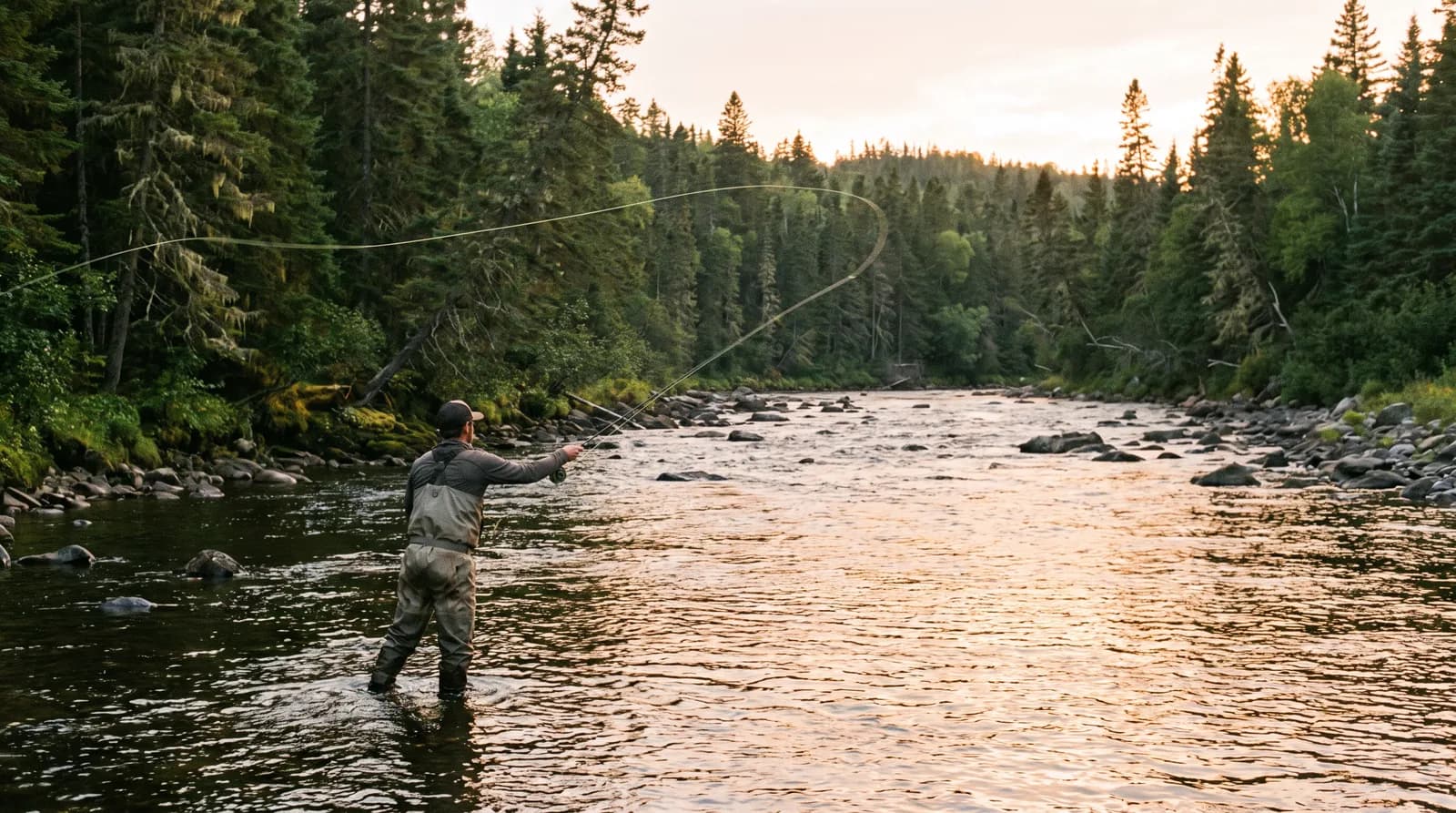
On scheduled salmon waters throughout Newfoundland and Labrador, you must angle with an artificial fly, and only one hook may be used at a time. The Anglers' Guide defines an artificial fly as a single barbless hook dressed with materials to attract fish. It may not be baited, weighted to sink, or fitted with a spinner or similar device.
In practice:
- Barbless hooks only. You can make a hook barbless by cutting or filing off the barb, or by pinching it flat against the shank.
- One fly at a time. No droppers or multi-fly rigs on scheduled salmon waters.
- One rod and line. In inland waters you may use only one rod and line at a time.
- No foul-hooking. Jigging and deliberate foul-hooking are prohibited, and an accidentally foul-hooked fish must be released.
Seasons and hours
For 2026 the Anglers' Guide listed the summer season as:
- Insular Newfoundland: June 1 to September 7.
- Labrador: June 15 to September 15.
Some individual rivers have different dates. DFO also listed a fall catch-and-release season (September 8 to October 7 in 2026) on selected main-stem sections of the Gander, Exploits and Humber rivers, subject to in-season review, with tributaries closed.
Angling on scheduled salmon rivers is allowed only from one hour before sunrise to one hour after sunset. DFO can change measures in-season, for example in response to low water or high water temperatures, so check for notices close to your trip.
When non-residents need a guide
Provincial rules decide whether a non-resident needs a guide, and they depend on where you fish:
- Island of Newfoundland and Labrador south of 52°N: a non-resident may not angle scheduled salmon waters unless accompanied by a licensed guide or by a direct relative who is a resident. Within 800 metres of a provincial highway, a non-resident does not need an outfitter but still needs a guide or resident direct relative.
- Labrador north of 52°N: non-resident trout and salmon anglers must use an outfitter, fish at a co-operative camp, or be accompanied by a direct relative.
That is why most visiting salmon anglers book through a fishing outfitter or lodge: the guide, the river access and often the logistics come together.
Questions to ask an outfitter
- Which rivers do you fish, and what class are they this season?
- Is the package catch-and-release only, or can guests keep a fish where the class allows?
- How are licences handled for guests?
- What fly patterns and line weights do you recommend for the river and month?
- What happens if a river is closed in-season for low water or warm water?
Next step
Browse Atlantic salmon outfitters, or look by area at the Central Region, home to the Gander and Exploits, the Western Region or Labrador. Combining salmon with brook trout? See trout and other fishing. Or get matched with a licensed outfitter.